
Hardy Plant Society/Mid-Atlantic Group
|
Members' Garden Tour 2026
Saturday, June 06, 2026, 10:00 AM - 6:00 PM EDT
Category: Annual Events & Programs
2026 HPS/MAG Member Garden Tour Saturday, June 6, 2026, 10:00 AM – 6:00 PM Garden Tours – 10:00 AM to 4:00 PM followed by a Reception – 4:30 PM to 6:00 PM at Westminster Presbyterian Church It is a rain-or-shine event. Members only. The tour is free, but registration is required. Guests are welcome but must join HPS/MAG at the first house they visit. We will be prepared at each house to sign up your guests. Dues are $35.00 for one year and $60.00 for two years. Important: Exact cash payment or payment by check is required on the day of the tour. NEW THIS YEAR….Reception will be limited to 220 members due to space constraints. To register for the Garden Tour Only click here. To register for the Garden Tour & Reception click here. Registration closes June 1. Click here to become an HPS/MAG member before registering for this event. Addresses and parking directions will be included in all registrants' confirmation emails. Volunteers will be needed for this event . Volunteers must also register for this event. Click here for the link to volunteer. Contact: Cathy Lane at [email protected] 1. Garden of Robert Grenfell 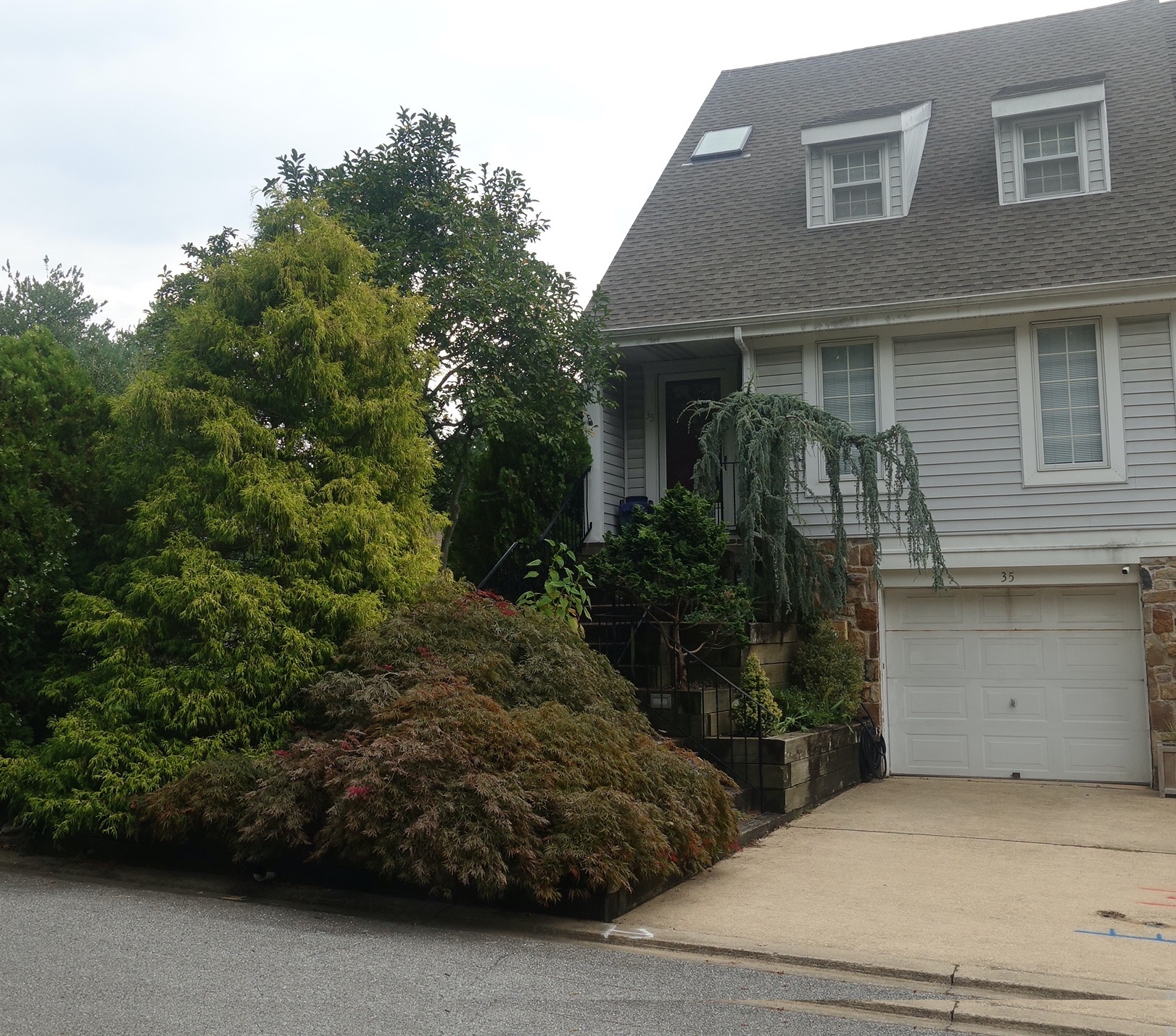
Three small gardens bracket this end-unit townhouse. Architectural tie steps wind up to the front door through planting beds featuring conifers and a cut-leaf Japanese maple. Boxwood, nandina domestica, leatherleaf viburnum, Burford holly, and perennials dress the side. And a small courtyard garden enclosed by arborvitae and euonymus hedges unites the garden styles of Japan and Charleston, S.C. Focal points include crape myrtles and a magnolia grandiflora, underplanted with nandina, hydrangea, Hosta, ferns, begonia grandis, caladium, and bulbs. A raised deck, rimmed with containers of herbs, overlooks a handsome 19th-century stone barn.
2. Thistle Garden of Radford MacFarlane 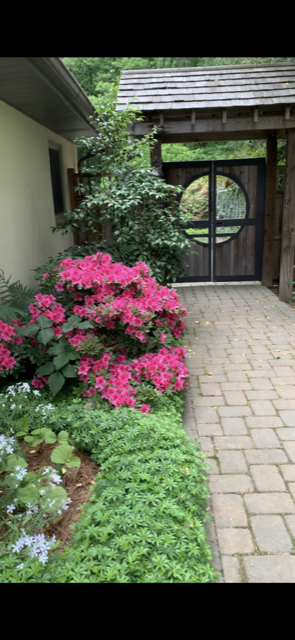
"Thistle" is situated on nearly 2 acres in North Wilmington and is located where the Coastal Plain transitions into the Piedmont Plateau (Garden Zone 7). An Asian aesthetic weaves together numerous gardens, including a Japanese courtyard, a rock-and-trough garden, small ponds, and a secluded woodland. Native plants, deciduous rhododendrons, alpines, and bulbs are in peak bloom in mid-spring. A variety of primulas and cypripediums are in bloom throughout May. A special treat awaits those who venture into the "magic wood." On warm and sunny spring days, the lucky visitor may see trolls and fairies at play deep in the forest.
3. Shortwood Garden of Deborah Krape
Landscaper Bill Duncan created his own garden at 19 Owl’s Nest Road, on partly wooded land that was in his family for generations. Ornamental trees and shrubs (many uncommon), along with original oak, beech and tulip poplar, provide the bones of this mature garden. Hardscaping and water features abound. The property was divided in three pieces and four years ago Meg Spurlin acquired the 2.5-acre portion remaining at number 19, containing the core of the garden and its many delightful “rooms”, terraces and seating areas . She has created several large flower borders, one following the brick serpentine path that winds through the open part of the garden.
6. Garden of Bob Wheland and Leslie Stanford
7. Goodstay Gardens 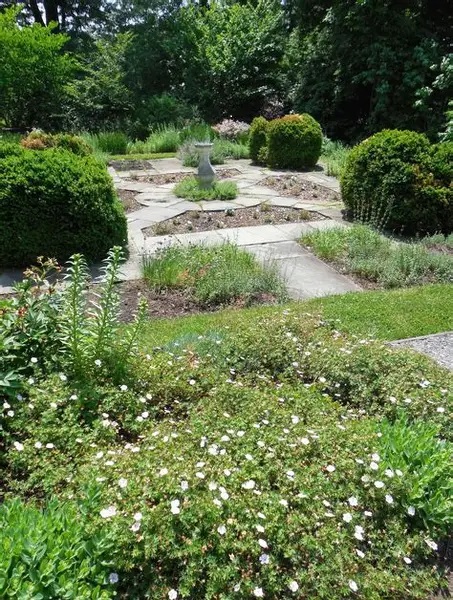
Is one of the oldest continuously kept gardens in the state of Delaware, dating back to the 1700’s. From the childhood home of Howard Pyle to the residence of generations of the DuPont family, this historic garden has many stories to tell. Goodstay Gardens is located on the University of Delaware's Wilmington Campus at 2700 Pennsylvania Avenue. The property was donated to the University of Delaware in 1968. The gardens are tucked away behind the Osher Center for Lifelong Learning and beside the Goodstay Center Mansion. The gardens are free and open to the public year-round from dawn to dusk. Friends of Goodstay Gardens manages the gardens' upkeep. This is a carry-in/carry-out garden with no restrooms or trash receptacles. They're famous for the Magnolia Walk, peonies, and iris displays that take over the grounds in the springtime. These gardens are Tudor-style, planned in the early 19th Century, and partitioned into "rooms" with level gravel paths and boxwood hedges.
8. Marian Coffin Gardens at Gibraltar
The estate and its garden slowly deteriorated after the deaths of both Hugh and Isabella Sharp. In 1998, Preservation Delaware (PDI), stepped in to preserve the property and restore the gardens. The historic mansion parcel is no longer owned by PDI, but PDI continues to maintain the Coffin gardens. A dedicated volunteer corps supports Preservation Delaware in planting, pruning, and seasonal care to keep the gardens thriving and welcoming to the public year-round. |
 Prev Month
 View Month
 Search
 Go to Month
 Next Month
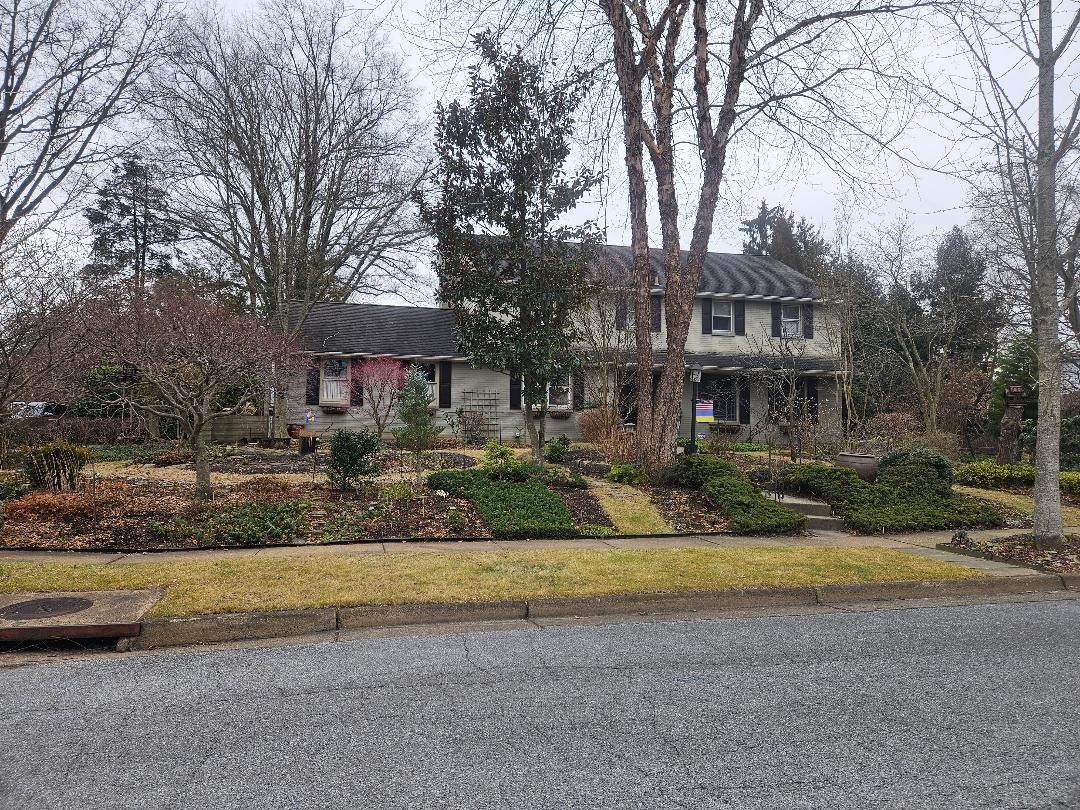 Shortwood Gardens, a small suburban collector’s garden in northern Delaware, has evolved over thirty years from traditional foundation plants and turf to a casual garden of beds, borders, and paths. Following the removal of foundation plants, the design focused on trees and shrubs selected to provide structure and interest. Creating a garden in a suburban development has often meant adapting the layout to the presence and, occasionally, disappearance of trees and shrubs along boundaries over which one has no control. The recent, unexpected loss of a mature stand of more than 100 100 ft fir trees on an adjacent property, the long-standing backdrop for an established perennial bed, left us with 1200 sq ft of bare ground. Although clearly a design challenge, our “new garden” has given us the opportunity to trial new arrangements of the plants we have added over the years: specifically chosen cultivars, as well as volunteers deemed worthy, retained, and often re-sited. Among the volunteers, there is a special group we consider VIP’s—volunteers-in-place, plants that have come up in just the right place and left to thrive “in situ.” However, Shortwood Gardens (and there is a story behind that name) is also a productive garden featuring an assortment of fruit trees, berry plants, and seasonal vegetables.
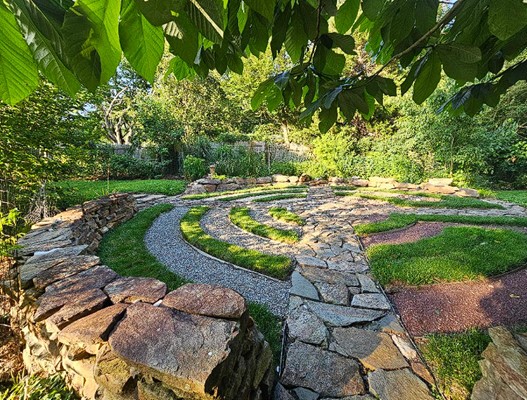 My wife and I bought a 1960’s rancher on ¾ acre at the end of 1998. There were no plants in the front, a row of tall arborvitae on one side, and a few enormous Silver Maples on the other, which have since been removed. The backyard had 2 large White Pines and 1 Walnut, both since blown over or removed. Two Walnuts and 1 Black Cherry exist in the far back. I slowly added a variety of trees, shrubs, and perennials in different sun and shade settings. The garden has Aesthetic, Functional, and Spiritual areas, of which some have a dual purpose. The garden consists of the River Birch Oval, the La Cage aux Fig, the Hill Top Veggie Garden and Cold Frame, several Hush-Hush Woodland Walks, Here Comes the Sun Perennial Borders, and a Labyrinth of Solace. Deer wreak havoc, so most beds are fenced and gated. There are found-object and whimsical sculptures sprinkled throughout as well as a collection of hostas, iris, epimedium, snowdrops and hellebores. Many of the plant specimens were from the Island of Misfit Plants, (bargain bins) and I offered them a place to thrive in this Garden of Second Chances.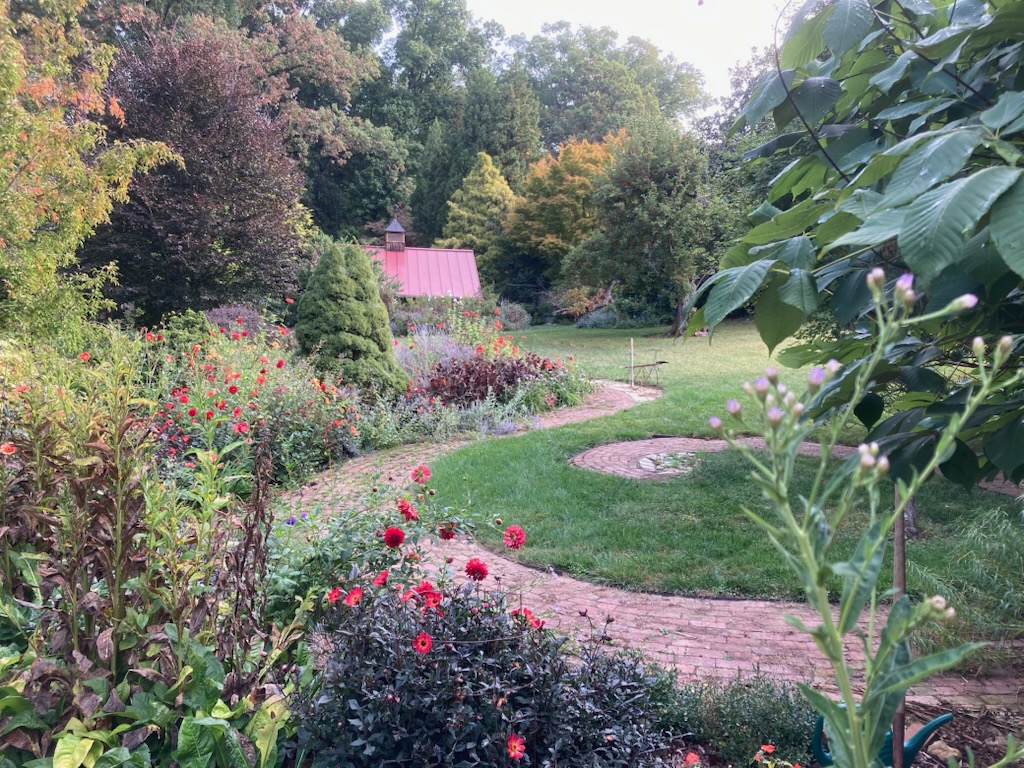
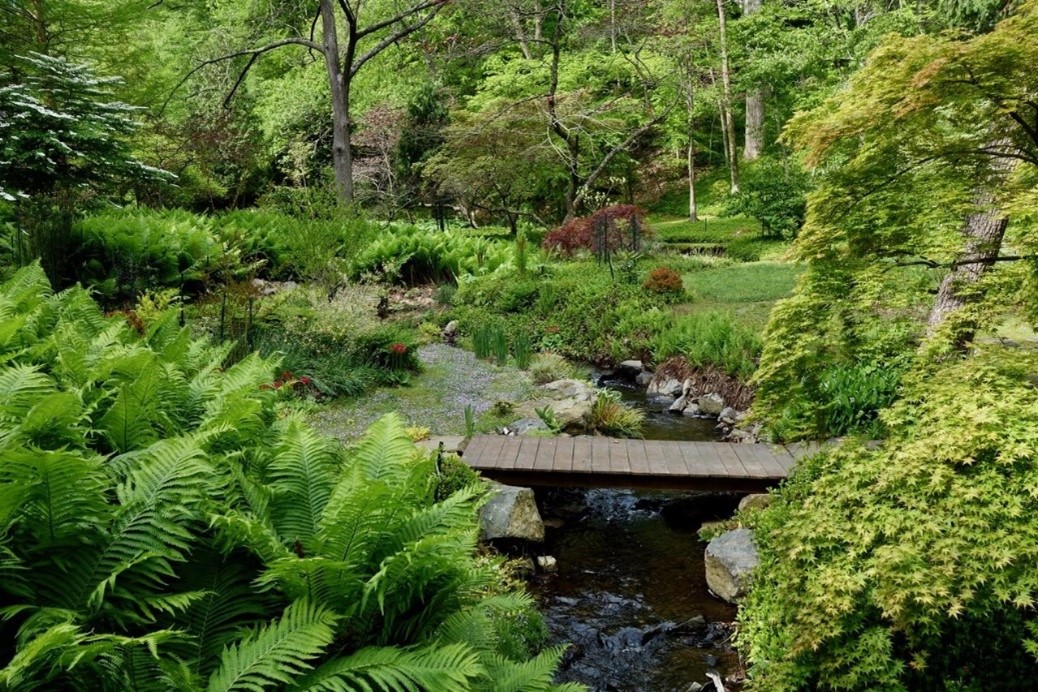 We purchased 4.7 acres lot in 1978, drawn by a long view down a sloping, forested hillside to a stream winding through an open field. After clearing brambles and vines to better enjoy the vista, it seemed sensible to stabilize the slope with ground covers. That practical decision—almost by accident—set in motion forty-six years of gradual, persistent garden creep. Today, the stream banks are largely covered with hosta, iris, saxifrage, primula, tiarella, ferns, petasites, and acorus. Much of the forest floor is carpeted with bulbs, ferns, carex, lamiastrum, epimedium, hellebores, bamboo, moss beds and a winding wood-piled maze. The field offers a walk through a grove of bamboo, dawn redwoods and patches of perennials. The steep slope connecting the house area to the field stream area can be accessed two ways from top to bottom; by stairs and a stony path, both steep.
 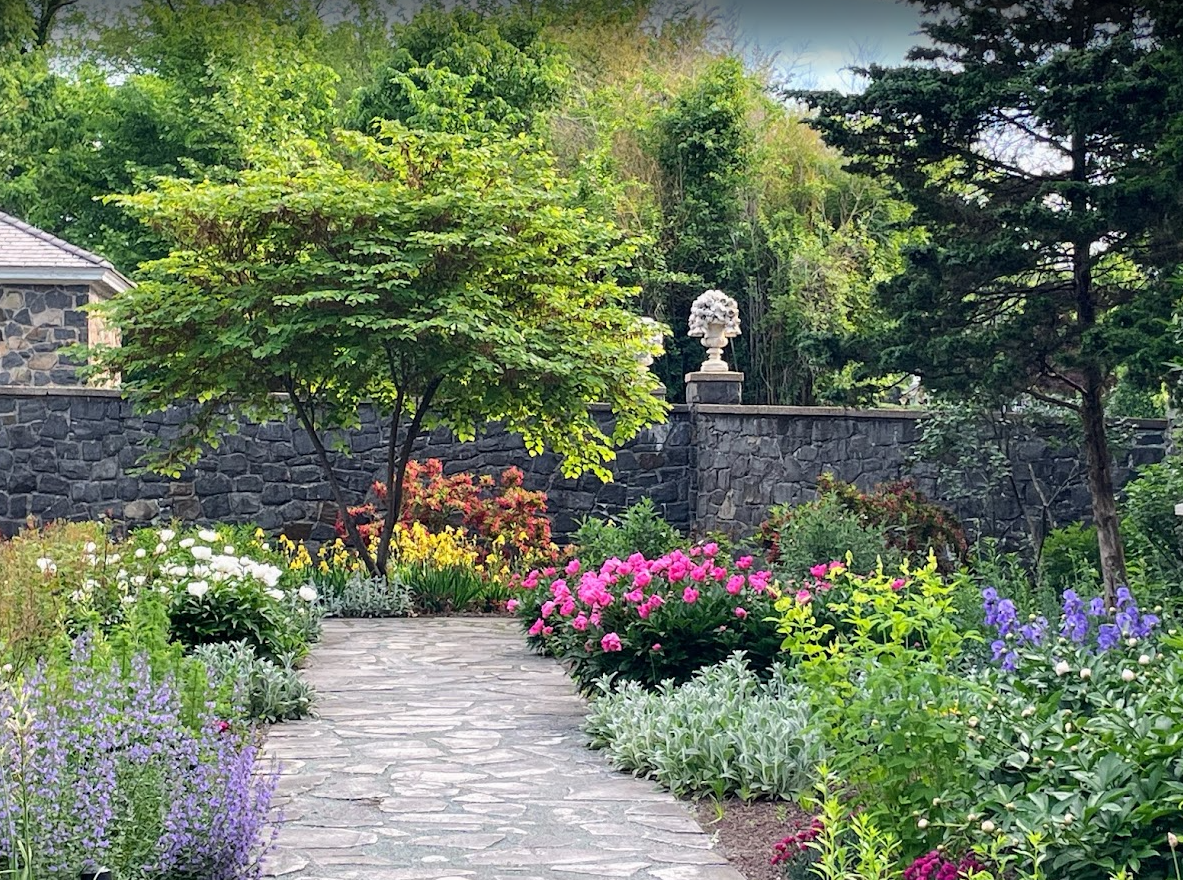 It is one of Delaware’s architectural heritage and historic gardens. Designed and built by Marian Cruger Coffin in the early 1900’s, the gardens were the first in a long line of high-profile contracts in Coffin’s exceptional career in landscape architecture, a field dominated by men at the time. When Hugh Rodney Sharp and his wife, Isabella Mathieu du Pont Sharp, purchased the Gibraltar estate in 1909, it was a 19th-century mansion with about 80 acres of impressive landscaping. Sharp expanded the home and added a conservatory, a carriage house, a greenhouse, a swimming pool, and an elaborate garden. In 1916, Hugh Sharp awarded Coffin the contract to design the Gibraltar estate gardens, choosing the Italianate Beaux-Arts style and envisioning each terraced area as a room or hallway in an outdoor mansion of its own. Each terrace has a unique theme or element, cascading through a colorful and artistically selected arrangement of flowers, shrubs, and trees. Primary elements create focal points in each area of the garden. A large tea house, through its high colonnaded archways, looks out upon a peaceful expanse of colorful flowering bushes along a row of cypresses.
 Export Event